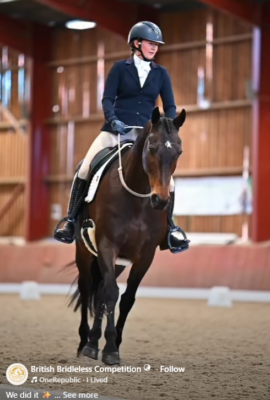
Riding bridleless has hit the spotlight! By now you’ve probably seen the footage of riders at the British Bridleless Competition in May 2026, cantering courses and popping over jumps with nothing on their horse’s head at all. It’s the kind of thing that stops people mid-scroll. And it’s sparked a question I get a lot at the moment: could I ever do that?
Back in the early nineties, when I was working my way up through the Parelli program toward becoming an instructor, riding with one rein was just part of the road. Everyone reaching for a higher level was doing it. Not because it looked good, but because it was how you proved your horse was actually listening to you, rather than to a piece of metal.
Why one rein, not two
I remember the question in my head before I started. How on earth am I going to control five hundred kilos of horse with one rein instead of two? It turned out, with the right groundwork first, to be far more straightforward than I expected.
Learning the parts before the whole
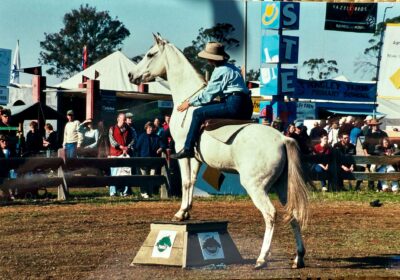
We built it from the ground up, literally. Teaching the horse to move their hindquarters from a feel of my hand simulating a leg, and their front end from the feel of the rope simulating a neck rein. A straight backup using a rhythmic lift of the rein. Once that was understood on the ground, it translated onto the horse’s back quickly. We started in a yard, kept it slow, and practiced the backup, the yields, the turns, the stop, before we ever asked for more space or a faster pace.
What that taught me, more than the riding itself, was how to separate every part of the horse and put it back together again. I knew exactly what was needed to move a hindquarter, a shoulder, a nose, instead of just hoping the whole horse responded to a vague pull. That’s the piece I’d point you toward if you’re starting your own bitless journey: get clear on the parts before you worry about the whole. Moving the hind end well is where I’d start, because it’s the one skill that carries you furthest, using a bridle or nothing on their head at all.
The first ride that taught me everything
There’s a piece of that training I still think about often, probably more than any other. A young horse starting course where our very first ride, on a horse who had never carried a rider before, was nothing more than learning to be a passenger on one rein. No insisting on a direction, just a pace. And sitting quietly while a young horse worked out that having weight on their back wasn’t something to fear.
That single decision, to start with one rein and no expectation of steering, taught me more about what a horse actually needs at the beginning than anything that came after it. It meant the horse’s first experience of being ridden had nothing to fight against. There was no second rein to brace into, no rider gripping for balance, nothing pulling on both sides of their mouth at once. Just one steady point of contact and a rider willing to be a passenger first and a director second.
What I didn’t expect about safety
It also taught me something I didn’t expect about safety. In a genuine, scary moment, one rein gives you more control than two, not less. Pull on both reins, which is most people’s instinct when a horse bucks or bolts, and the horse has something solid either side to brace against and lever into. Take that away and there’s nothing to push against. I stopped leaning on my reins for balance too, and I learned to use rhythmic rein pressure to give the horse nothing to lean on.
Every horse I’ve started since has begun the same way. Not because the method demands it, but because that first ride taught me what actually matters at the beginning: a horse who feels nothing to fight, and a rider who isn’t asking for much beyond quiet acceptance.
Here’s a detailed two-part video of the exact steps I learned for one-rein riding.

What I’d do differently today
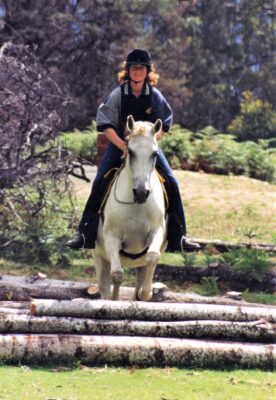
I no longer teach Parelli, and I wouldn’t tell you to follow any method to the letter. But it gave me a genuine roadmap at a time I needed one, and it’s the reason I could ride any horse I worked with bit-free and start young horses bitless from day one. If I were still riding today, I’d lean further still, toward as few tools as possible, closer to the Freedom Based Training® that Elsa Sinclair has developed and shown at Taming Wild than the program I came up through. The destination hasn’t changed. How I’d walk there has, and you may choose an entirely different one from the many good horsemanship programs and trainers available.
Where bridle-less actually fits
Bridleless, one rein, a cordeo/neck rope, a bitless bridle, they’re not separate goals with a right answer, they’re different goals along the same line. What matters more than which one you’re aiming for is making sure each step is trained thoroughly before you move to the next. Start with a bitless bridle, test your foundation with one rein, then progress to a cordeo or neck rope, and finally bridle-less, if and when that’s where you want to go.
If you’ve got a genuine fear sitting underneath any of this, my advice hasn’t changed since 1994. Learn about it, teach it on the ground first, and keep your early rides in a small, contained space until both of you trust it. Success and safety come from preparation done properly, not from confidence borrowed from someone else’s highlight reel.